Elite Gourmet
Elite Gourmet ESB-301BF Countertop Burner
$16.991,000+ bought last month
View on Amazon
A typical single countertop burner measures roughly 9 to 11 inches wide and 9 to 12 inches deep, so it fits almost anywhere with room to spare for a pot handle. Double burners nearly double that footprint, usually running 18 to 21 inches wide. Before buying a double unit, set a cutting board or sheet pan down in the spot where you plan to use it and see how it feels. Kitchens with limited counter runs often find a double burner crowding the workspace around it, making a single the smarter call even if you occasionally wish you had two zones.
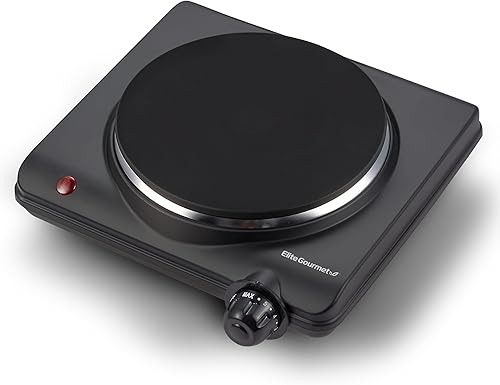
Single electric countertop burners typically draw 1,000 to 1,800 watts per element. The Elite Gourmet ESB-301BF, for example, is a 1,000-watt single-burner model that handles everyday simmering and reheating on a standard 120-volt outlet at just $16.99. The duxtop BT-180G3 steps up to 1,800 watts, giving faster boils and better sear heat, while still running on the same household circuit. Double burners split or share that draw, so check whether both elements can run at full power at the same time or whether the unit throttles one zone when both are on. Most budget double burners run one element at reduced wattage when both are active, which can slow your cook.
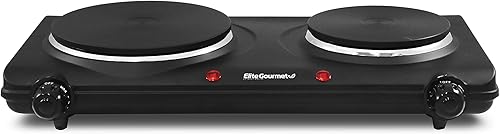
A double burner shines in a few specific situations: cooking Thanksgiving side dishes with a broken range, running a small catering setup, feeding a family of four or more from a single countertop station, or doing hot pot and fondue at the table where two separate heat zones let guests manage their own side. The Elite Gourmet EDB-302BF is a popular choice for this at $27.99 with over 19,700 buyer reviews, giving two burners with independent knob controls for straightforward use. Outside those scenarios, most home cooks reach for the second zone far less often than they expect.
The cost gap between a basic single and a comparable double is usually in the ten to twenty dollar range at the budget tier, and twenty to fifty dollars at mid-range. That sounds small, but the bigger cost is counter real estate, which you pay every time you cook. If your kitchen is already tight, spending the extra money on a double unit that sits on the counter unused 80 percent of the time rarely makes sense. A second single burner stored in a cabinet and pulled out only when needed gives you the same flexibility without the permanent footprint.
Single burners are genuinely portable: at 2.4 to 3.5 pounds for most knob-control models, they slide into a cabinet drawer or tuck on a shelf with ease. Double units are heavier, often 5 to 13 pounds, and wider, making them harder to store when not in use. If you plan to take a burner camping, to a vacation rental, or to a tailgate, a single is the obvious pick. The duxtop BT-180G3 weighs 5.8 pounds and measures 11.5 by 13 inches, making it a compact but capable single-zone induction option you can carry without effort.
For backup cooking, a spare burner for boiling water, or a dorm or small apartment setup, start with a well-reviewed single. The Elite Gourmet ESB-301BF has 25,100 reviews and sells for under $17, making it the easiest recommendation at the budget end. Step up to the duxtop BT-180G3 at $70.99 if you want 1,800-watt induction speed and a glass surface that cleans in seconds. Choose the Elite Gourmet EDB-302BF at $27.99 if you genuinely need two independent zones and want to spend as little as possible to get them. Match the burner count to your cooking habits, not to what sounds more capable on paper.
It depends on the model. Budget double burners often share a single heating element or throttle one zone to stay within a standard 15-amp household circuit. Check the wattage label for each zone separately. If the spec just lists a combined total, assume both zones running together will be slower than one zone at full heat.
Yes, for most everyday cooking. You can simmer a sauce, boil pasta, saute vegetables, or fry eggs perfectly well on a single unit. Where it gets limiting is when you need to hold one dish warm while actively cooking another at the same time. For single-person or two-person households, one burner handles a solid majority of meals without any real workaround.
Most double models run 18 to 21 inches wide, which is significant on a tight counter. Measure the spot you have in mind before buying and factor in pot handles extending beyond the burner edge. If counter space is already limited, two compact singles stored separately and used as needed often work better than one wide double unit that never moves.
For general cooking, 1,000 to 1,100 watts is enough for simmering, warming, and light sautes. For faster boils and higher heat, look for 1,500 to 1,800 watts per zone. The duxtop BT-180G3, for instance, runs 1,800 watts as a single induction burner, which gets water boiling noticeably faster than lower-wattage electric coil models. Stay within your circuit's capacity, typically 15 or 20 amps, when running multiple appliances.
Electric single burners work well anywhere you have a standard 120-volt outlet, making them practical for hotel kitchenettes, vacation rentals, offices, and RVs. They are not suited for outdoor camping without power access. Lightweight models like the Ovente BGI101S at 2.4 pounds are easy to pack. For true off-grid cooking, a butane or propane portable burner is the better fit.