Elite Gourmet
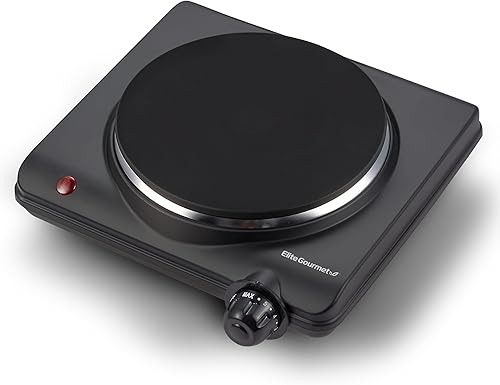
Elite Gourmet ESB-301BF# Countertop Burner
$16.991,000+ bought last month
View on Amazon
Wattage on a countertop burner is a ceiling, not a constant. A 1800-watt model runs at full power only when the coil or induction coil is calling for maximum heat. At lower settings, it draws far less. What wattage determines in practice is how fast the burner can recover heat after you add cold food, how quickly it brings a full pot of water to a boil, and whether it can hold a true rolling boil under a heavy load. A 1000-watt burner like the Elite Gourmet ESB-301BF at $16.99 is perfectly adequate for reheating or making a single portion of pasta, but it will struggle to keep a large stockpot at a hard boil. The higher the wattage, the more flexibility you have across different cooking tasks.
Burners in the 1000 to 1100 watt range are compact, lightweight, and inexpensive. The Imusa GAU-80305 at $14 pulls 1100 watts through a simple knob control and weighs about 2.6 pounds, making it easy to store or pack for a dorm or small apartment. At this wattage you can warm soups, melt chocolate, make oatmeal, and cook eggs without a problem. Where 1000 to 1100 watts falls short is speed: boiling two quarts of water for pasta takes noticeably longer compared to a 1500-watt or 1800-watt unit, and the burner may lose the boil if you add a large batch of cold food at once. For a single person who cooks light, this range is fine; for a family or for pressure cooking, it is too limiting.
Most home cooks who want versatility without maxing out an outlet land in the 1400 to 1500 watt range. The Nuwave PIC FLEX Precision Induction at $59.99 draws 1400 watts and uses induction technology, which means the heat goes directly into the pot rather than into the air around it. That efficiency gain effectively narrows the performance gap with a 1800-watt coil burner. At this wattage you can bring water to a boil in a reasonable time, saute vegetables, and maintain a steady simmer for braises or sauces. The 1400 to 1500 watt band is also gentler on shared circuits, which matters if your kitchen outlet is on a circuit with other appliances.
1800 watts is the practical maximum for a single-burner countertop unit on a 120-volt, 15-amp household circuit without tripping a breaker. The duxtop BT-180G3 at $70.99 is one of the most reviewed 1800-watt induction burners available, with a glass surface, push-button controls, and over 17,000 buyer ratings. At 1800 watts, water comes to a boil quickly, a cast iron pan preheats in a fraction of the time a 1000-watt unit needs, and recovery heat after adding cold proteins is fast enough to hold a proper sear. If you plan to use a countertop burner as a primary cooking surface rather than a backup, 1800 watts is the wattage to buy.
For coil burners, wattage translates to how hot the coil gets, and some of that heat radiates into the surrounding air rather than into the pan. Induction burners generate heat directly in the cookware through a magnetic field, so a 1400-watt induction unit often performs comparably to a 1600-watt coil burner in everyday tasks. This is worth knowing when comparing spec sheets: a lower wattage induction model can outperform a higher wattage coil model in real cooking situations. The tradeoff is that induction requires compatible cookware, meaning cast iron, most stainless steel, or pots and pans labeled induction-ready. Aluminum or copper pans will not work on an induction countertop burner.
A standard 15-amp, 120-volt household circuit can safely handle about 1440 watts of continuous load, which is why 1800-watt burners are designed to cycle power rather than run flat-out continuously. Running any high-wattage countertop burner on the same circuit as a microwave, toaster, or refrigerator risks tripping the breaker. The practical advice: plug your burner into a dedicated outlet if possible, or at least one that is not shared with another high-draw appliance. If you rent and cannot control the wiring, a 1400-watt induction model is a safer daily-driver choice than an 1800-watt coil unit. Never use an extension cord with a countertop burner rated above 1000 watts.
1000 watts is enough for basic tasks like warming food, melting butter, making eggs, or cooking single-serving meals. It is not well-suited for boiling large pots of water quickly or maintaining a hard boil under a heavy load. For light, occasional use it works fine. For daily cooking of full meals, you will want at least 1500 watts.
It can, if the outlet is on a standard 15-amp circuit already loaded with other appliances. A 15-amp circuit at 120 volts handles about 1440 watts of continuous load safely, so an 1800-watt burner should run on a circuit by itself or with only low-draw items. Plugging it into an outlet shared with a microwave, toaster, or coffeemaker at the same time is a common cause of tripped breakers.
Not necessarily. Wattage determines how fast a burner can add heat, but temperature precision depends on the control system. A burner with digital touch controls or multiple discrete power levels can hold a steady simmer more accurately than a knob-control unit even at the same wattage. Look at the control type alongside the wattage when precision matters, such as for candy making or tempering chocolate.
Canning requires maintaining a sustained rolling boil under a large, full pot, which puts a real load on any burner. For water-bath canning, 1800 watts is the practical minimum for a countertop electric unit. Note that many induction burners are not recommended for canning because the magnetic field can interact poorly with the large canning pot and cause uneven heating or error shutoffs. A coil or radiant electric burner at 1800 watts is a safer choice for canning.
Not safely if both are high-wattage models. Two 1000-watt burners together draw 2000 watts, already over the safe continuous limit for a 15-amp, 120-volt circuit. Two 1800-watt burners would draw 3600 watts and would immediately trip a standard breaker. If you need a two-burner setup, look for a single double-burner unit engineered to share power across both elements, or use two separate dedicated circuits.

