Elite Gourmet
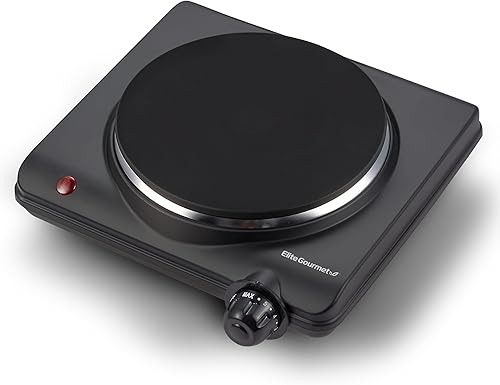
Elite Gourmet ESB-301BF# Countertop Burner
$16.991,000+ bought last month
View on Amazon
Wattage tells you how quickly a countertop burner can deliver heat. Models range from 1000W on the low end up to 1800W or 2000W on the high end. A 1000W unit like the Elite Gourmet ESB-301BF# ($16.99, 4.4 stars across 14,600 buyers) handles simmering soups, warming sauces, and melting butter without trouble, but it will take noticeably longer to bring a large pot to a boil. An 1800W burner, such as the duxtop BT-180G3, reaches boiling temperature significantly faster and can handle a full sear or a rolling stir-fry. If you cook full meals on the countertop burner, treat 1500W as your minimum and 1800W as the target.
Electric coil burners heat a metal coil that then heats your pan, while induction burners use an electromagnetic field to heat the pan directly. Induction is faster, more energy-efficient, and the glass surface stays cooler to the touch, which reduces the risk of burns on an accidentally spilled stovetop. The catch is that induction only works with magnetic cookware, meaning cast iron and most stainless steel pans are compatible, but aluminum, copper, and many nonstick pans are not. If you are unsure whether your pots qualify, hold a fridge magnet to the bottom. Electric coil burners work with any cookware and cost less up front, making them the simpler choice when you already own a mixed set of pans.
A single countertop burner is compact enough to tuck away in a cabinet and covers the most common scenarios: extra burner space during the holidays, cooking in a dorm or office, or replacing a stove in a small apartment. A double burner costs more, takes up more counter space, and weighs more, but it lets you run two dishes at once without any juggling. If you realistically only cook one thing at a time on the unit, the single burner is the smarter buy. If you use the countertop burner as your primary cooking surface, a double-burner model earns back the extra cost quickly in convenience.
Most single countertop burners measure roughly 9 to 11 inches across the cooking surface and weigh between 2 and 6 pounds, which makes them easy to move and store. Double burners can run 20 inches wide and top 10 pounds. Before buying, measure the counter space you plan to use and check that the burner dimensions leave clearance on all sides for safe airflow. If you plan to store the unit between uses, weight matters more than most buyers expect. The duxtop BT-180G3 is 11.5 by 13 inches and weighs 5.8 pounds, a size that fits comfortably on most kitchen carts or shelves.
Budget models under $20, like the Elite Gourmet ESB-301BF# at $16.99, deliver honest value for light use, reheating, and a backup burner you pull out a few times a week. Mid-range models in the $50 to $90 range, including the duxtop BT-180G3 at $70.99 with 17,200 buyer reviews, offer 1800W output, better build materials, and more stable heat control that holds up to daily cooking. Above $100 you generally gain precision temperature settings, better glass surfaces, and expanded wattage increments. Spend more only if you cook frequently at the countertop or need features like a temperature probe input or fine-grained wattage steps.
For general cooking, 1800W is the practical target. It brings water to a boil quickly, holds a true fry temperature, and handles searing without losing heat when cold food hits the pan. A 1000W model works for simmering and reheating but will feel noticeably slow for any high-heat task. If storage space is no concern and you cook full meals on the unit, 1800W is worth prioritizing over every other spec.
Induction works only with cookware that has a magnetic base, which includes cast iron and most stainless steel. Aluminum, copper, and ceramic pans without a magnetic plate on the bottom will not heat on an induction surface. The fastest check is a fridge magnet. If the magnet sticks firmly to the bottom of the pan, it will work. If the pan is not compatible, an electric coil burner is the simpler option.
Electric coil burners radiate heat outward and downward, so they should always sit on a heat-resistant surface and never on laminate or plastic counters without a protective mat underneath. Induction burners are safer in this regard because the surface does not get as hot and the heat transfer is directed upward into the pan. Either way, leave a few inches of clearance around all sides and never place the unit directly under overhanging cabinets while in use.
Let the surface cool completely before cleaning. For everyday cleaning, a damp cloth and a small amount of dish soap is enough. Stubborn residue responds well to a paste of baking soda and water left for a few minutes, then wiped away with a soft cloth. Avoid abrasive scrubbers or steel wool, which scratch the glass surface. Do not use the glass cooktop as a cutting board or set heavy objects on the edges, as the corners are the most vulnerable point.
Yes, many people do this successfully in studio apartments, dorms, and RVs. A single 1800W burner handles most stovetop tasks well. For a more complete setup, a double burner gives you the flexibility to run two dishes at the same time, which makes meal prep significantly easier. Pair the burner with a countertop oven or air fryer if you also need to bake or roast, and you have a full kitchen in a compact footprint.

