Air Fryer vs Convection Oven: What Actually Matters for Home Cooks
Recommended picks


How Air Fryers and Convection Ovens Actually Work
Both appliances rely on a heating element and a fan that circulates hot air around the food. The key difference is geometry. An air fryer forces air through a tight basket, which means the air moves faster past the food surface and pulls away moisture more aggressively. That rapid moisture removal is why air-fried food comes out crunchier than food cooked in a convection oven at the same temperature. A convection oven has a larger interior, so the airflow is gentler and more even across a full sheet pan or roasting rack. Neither approach is better in every situation; they are optimized for different tasks.
Capacity and Countertop Footprint
Most standalone air fryers range from about 2 quarts for a single-serving basket up to 15 or 16 quarts for a family-size oven-style unit. The Nuwave 15.5-Qt X-Large, rated 4.4 stars across more than 16,000 buyers and priced at $161, sits at the large end and can handle a whole chicken or multiple trays of fries without batching. At the compact end, the Nuwave 6QT Brio (6 quarts, 1800 watts, nonstick basket, $130, 4.4 stars) is a better fit for one to three people. A countertop convection oven typically starts at 12 to 18 quarts and climbs from there, offering more interior height for roasting pans and casseroles. If you already own a full-size convection range, a separate countertop unit overlaps a lot with what you already have.
Speed and Wattage
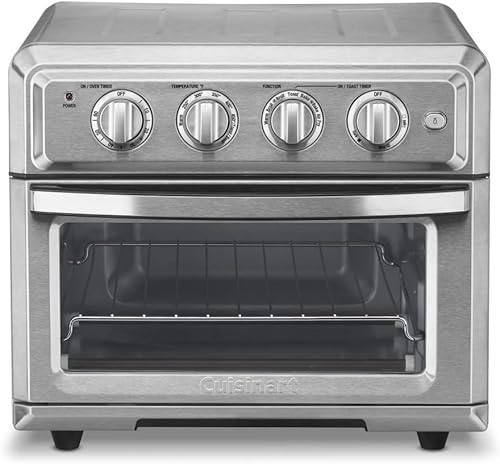
Air fryers preheat in two to four minutes versus five to ten minutes for most countertop convection ovens. That speed advantage compounds across short cooks: frozen fries that take 25 minutes in a convection oven are often done in 12 to 15 minutes in an air fryer basket. Wattage varies by model, not appliance type. The Cuisinart TOA-60ES runs at 1800 watts and reaches a maximum temperature of 450 degrees F, which is competitive with many mid-range convection ovens. Higher wattage generally means faster preheat and more consistent temperatures at the top end of the dial, so it is worth checking that spec before buying.
What Each One Does Best
Air fryers shine for frozen snacks, chicken wings, french fries, reheating pizza, and anything where a crackly exterior matters. They are less suited for delicate baked goods, full sheet-pan dinners, or anything that needs moisture retained through a long cook. Convection ovens handle all of those tasks and also do a better job on multi-rack baking where even browning across several trays is important. Some oven-style air fryers, like the Cuisinart TOA-60ES, blur the line by combining an air-fry basket with a larger stainless steel cavity that can also toast, bake, and broil, giving you more flexibility from a single countertop appliance.
Cleaning and Maintenance
Basket-style air fryers are generally easier to clean than countertop convection ovens. The basket and tray drop out and can be washed in a sink; many have nonstick coatings that wipe clean in seconds. Convection ovens have more interior surfaces, crumb trays, and rack guides to deal with. If baked-on grease is a pain point for you, a basket air fryer with a nonstick interior will require less scrubbing. Oven-style combo units fall in between, since they have both removable baskets and a larger cavity that collects splatter.
Price and Value
Compact basket air fryers start below $50 and a solid mid-range model runs $60 to $130. Oven-style air fryers that can also function as a convection oven typically run $100 to $270. Countertop convection ovens span a similar range but often cost more at the higher end because of larger cavities and more robust heating elements. For most home cooks who do not already own a convection oven, an oven-style air fryer in the $130 to $200 range offers the best dollar-per-cooking-task ratio because it handles both fast air frying and standard baking.
Common mistakes to avoid
- Buying a basket that is too small for your household and constantly cooking in batches, which wipes out the speed advantage.
- Assuming a convection oven and an air fryer are the same thing because both use a fan, and then being surprised by different textures and cook times.
- Overcrowding the air fryer basket, which blocks airflow and gives steamed, not crispy, results.
- Setting the temperature too high to save time and burning the outside before the inside is cooked through.
- Skipping the preheat step on a convection oven, which leads to uneven browning and longer total cook times.
- Ignoring wattage when comparing models; a lower-wattage air fryer may underperform at high temperature settings even if the capacity looks right.
Frequently asked questions
Is an air fryer just a small convection oven?
They share the same core technology, hot air circulated by a fan, but an air fryer moves air faster through a smaller space. That concentrated airflow pulls surface moisture away more quickly, which is why air-fried food gets crispier than food cooked in a convection oven at the same temperature setting. Size, speed, and resulting texture are the real differences, not the underlying mechanism.
Can a convection oven replace an air fryer?
A convection oven can do most of what an air fryer does, but the results on things like wings, fries, and frozen snacks will not be as crispy because the airflow is slower and the cavity is larger. If crunchy texture is a priority, a dedicated air fryer or an oven-style combo unit with a true air-fry basket will give you better results on those tasks. For baking, roasting, and larger meals, the convection oven wins.
What size air fryer do I need for a family of four?
A 5 to 6 quart basket air fryer handles most side dishes and snacks for a family of four, though you may need to cook proteins in two rounds. If you want to cook an entire meal at once, step up to an oven-style air fryer in the 12 to 16 quart range. The Nuwave 15.5-Qt X-Large is a common pick in this range, with enough interior room for a whole bird or four portions of chicken thighs in a single cook.
Do air fryers use more electricity than convection ovens?
Most air fryers draw 1200 to 1800 watts, similar to many countertop convection ovens. Because air fryers cook faster, total energy consumption per meal is often lower even if wattage is comparable. A 15-minute air fryer cook at 1700 watts uses less energy than a 30-minute convection oven cook at the same wattage, so the speed advantage translates into modest savings on electricity over time.
Which is better for reheating leftovers?
An air fryer is the better choice for reheating anything with a crust or breading, pizza, fried chicken, egg rolls, fries, because it restores crispiness that a microwave destroys. A convection oven is better for reheating casseroles, large portions of roasted meat, or anything that benefits from gentle, even heat across a bigger surface. For everyday leftover reheating, most households get more use out of the air fryer.