What Size Electric Skillet Do I Need for My Kitchen?
Recommended picks


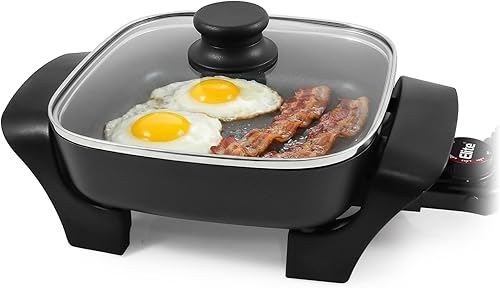
Small Skillets (Under 12 Inches): Best for 1 to 2 People
Compact electric skillets in the 8 to 12-inch range are light, easy to store, and heat up quickly because there is less surface area to warm. The Elite Gourmet EG808 is a good example: it measures 13.4 x 8.3 inches and draws only 600 watts, making it gentle on the power bill and easy to tuck into a cabinet between uses. At just 3.4 pounds it is one of the lightest countertop options in this category. The tradeoff is obvious: you cannot fit much more than two chicken thighs or a couple of portions of stir-fry at once. If you routinely cook for only yourself or one other person, that limitation rarely matters.
Mid-Size Skillets (12 x 14 to 12 x 16 Inches): The Sweet Spot for Most Households
A 12 x 15 to 12 x 16-inch electric skillet covers most weeknight cooking without eating up your entire countertop. The Bella 35258 lands squarely in this range at 12.4 x 16.2 inches and 1200 watts, with a stainless steel body and a weight of 7.1 pounds. At $49.99 with over 16,600 buyer ratings it is one of the most proven mid-size options available. The Presto 7117 is another solid mid-size pick at 12.13 x 15.75 inches, 1250 watts, and a nonstick cooking surface that makes cleanup straightforward. These skillets fit comfortably on a standard kitchen counter and handle everything from pancakes for four to a full pound of ground beef.
Large Skillets (12 x 18 to 12 x 20 Inches and Up): Families and Entertaining
If you regularly feed five or more people, or you like to cook complete one-pan meals, a large electric skillet gives you the room to do it. The Presto 06857 measures 12 x 20 inches and pulls 1500 watts, which is enough wattage to keep that wide aluminum surface at a consistent temperature even when loaded with food. It weighs 8.55 pounds, so it stays put on the counter during use. With a 4.7-star rating from nearly 16,000 verified buyers it has one of the strongest track records in the category. The larger footprint does mean you need about 20 inches of clear counter space, and storage can be tighter in smaller kitchens.
Wattage and Size Go Together
A bigger cooking surface needs more wattage to heat evenly. Most small skillets run 600 to 1000 watts, mid-size models land around 1200 to 1350 watts, and full-size 12x20-inch skillets typically draw 1500 watts. Going below the right wattage for the pan size means the temperature drops sharply when you add cold food, and recovery is slow. When you compare models, check that the wattage is appropriate for the cooking surface rather than just looking at dimensions alone. A 1500-watt skillet like the Presto 06852, which draws that wattage at its large footprint and aluminum construction, keeps the surface temperature stable across the whole pan.
Counter Space and Storage: The Practical Limits
Physical dimensions on the product page include the handles, which add 3 to 4 inches beyond the cooking surface itself. A skillet listed as 12 x 20 inches may need closer to 24 inches of total clearance when handles are factored in. Depth matters too: most models with glass lids sit 7 to 8 inches tall when the lid is on, so they do not fit under standard upper cabinets when in use. If you plan to leave the skillet on the counter permanently, measure your available space before ordering. If you need to store it between uses, check the weight: a 9-pound aluminum skillet is manageable but not something most people want to haul in and out of a low cabinet daily.
What to Ignore When Shopping by Size
Many listings describe electric skillets in quart capacity, but that measurement does not tell you much about the flat cooking surface that actually matters for searing, browning, or cooking multiple pieces of food at once. Focus on the length and width in inches rather than quarts. Similarly, the number of temperature presets has nothing to do with how much food the pan holds. Shop for surface area first, then check wattage, weight, and the nonstick or ceramic coating that fits your cooking habits.
Common mistakes to avoid
- Buying a large skillet but choosing a model with only 600 to 1000 watts, which cannot heat the full surface evenly
- Ignoring handle length in the product dimensions, then finding the skillet does not fit the available counter space
- Picking a 9-plus-pound skillet without realizing how awkward daily storage will be in a small kitchen
- Assuming a bigger skillet is always better, when a compact model heats faster and uses less energy for small batches
- Confusing quart capacity ratings with actual cooking surface area when comparing models
- Buying a mid-size skillet to save money, then using it to cook for six people where a larger surface would have prevented crowding and uneven cooking
Frequently asked questions
What size electric skillet is best for a family of 4?
A 12 x 16-inch electric skillet comfortably handles meals for four people. That surface area fits four chicken breasts, a full batch of pancakes, or a pound of ground beef with vegetables without crowding. If your family runs toward bigger appetites or you often have a fifth person at the table, step up to a 12 x 20-inch model. The extra length makes a real difference when you need to cook everything in one batch rather than two.
Is a 12-inch electric skillet big enough?
A square or round 12-inch skillet is fine for 1 to 2 people but gets tight for larger meals. Most rectangular electric skillets list 12 inches as the width, with the length telling you the actual usable surface: a 12 x 15-inch pan gives you roughly twice the room of a round 12-inch pan. If you see a model listed simply as 12 inches without a second dimension, confirm the full footprint before buying.
Does a bigger electric skillet use more electricity?
Yes, larger skillets typically draw more wattage to heat the bigger surface, but the difference is modest for occasional home cooking. A 600-watt small skillet versus a 1500-watt large one means roughly 0.9 kWh more per hour of use, which amounts to pennies on most utility rates. The more practical concern is that under-powered large skillets heat unevenly, which wastes more energy and cooking time than the wattage difference itself.
Can I use an electric skillet as my only pan?
For everyday cooking, a mid-size to large electric skillet covers a surprising range of tasks: sauteing, frying, braising, making pancakes, and simmering sauces. The flat countertop surface heats more evenly than many stovetop burners, and temperature control is usually more precise. The main limits are cooking tasks that need high-sided walls, like deep frying large batches, or tasks that need a round bottom, like wok cooking. For a small apartment kitchen it can absolutely serve as the primary cooking surface.
How do I know if an electric skillet will fit in my cabinet?
Measure the inside of your cabinet shelf before ordering: height, width, and depth. Add about 3 to 4 inches to the pan length listed in the product specs to account for both side handles. Most mid-size to large skillets are 7 to 8 inches tall with the lid on and 5 to 6 inches tall without it, so removing the lid for storage saves meaningful vertical space. If the skillet comes with a glass lid, store the lid separately or on top of the inverted pan to keep the stack lower.