How to Choose an Electric Hot Pot
Recommended picks


Capacity: Match the Quarts to Your Household Size
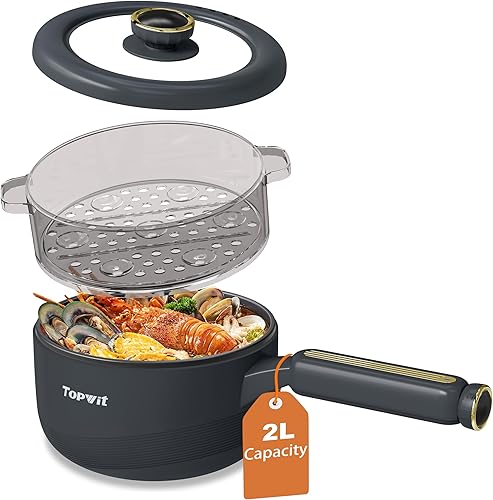
Capacity is the most important spec to nail down before you buy. A 1.6 quart hot pot like the Audecook AC800 (ASIN B0CJBGPTK9, 1.8 qt, 4.7 stars across 573 reviews) suits a single person making ramen, oatmeal, or a quick noodle bowl. Step up to around 2.1 quarts, as seen on the TopWit XK2001-1 (ASIN B0D3BZVTV9, 4.5 stars across 520 reviews), and you cover a couple or a light two-person shabu-shabu session. For a family or a tabletop hot pot party, look at 3.2 quarts and above, which is the range where models like the Starfrit 024425-002-0000 (ASIN B08L9R1L6S, 3.2 qt, 4.5 stars across 394 reviews) start to shine. Buying too small means constant refilling and waiting; buying too large wastes energy and counterspace.
Wattage and Heating Speed
Wattage tells you how quickly the hot pot reaches a rolling boil and how well it holds a simmer. Budget countertop models often run at 600 watts, which is enough for noodles, instant soups, and simple dorm-room cooking. The TopWit T210 (ASIN B08CGWDG9N, 600W, 4.4 stars across 968 reviews) is a good example of what that power level can do reliably. If you want to poach, braise, or bring a divided shabu-shabu pot to temperature quickly at the table, look for 1000 watts or more. Higher wattage also gives you more precise low-heat simmering because the element cycles less aggressively once the target temperature is reached.
Inner Pot Material: Nonstick vs. Ceramic
The material of the inner cooking surface shapes everyday cleanup as much as cooking performance. A nonstick inner pot, like the one on the Audecook 500-8617FR (ASIN B0CJBGPTK9, nonstick finish, 4.7 stars), releases food easily and wipes clean with minimal effort, which matters when you are making sticky rice or egg dishes. Ceramic inner pots hold heat evenly and are generally considered a better surface for acidic broths or tomato-based soups. Stainless steel pots are the most durable, but food sticks more readily unless you keep liquid in the pot at all times. Whatever the material, check whether the inner pot is removable, because a fixed bowl that cannot come out makes thorough cleaning far harder.
Controls: Touch Panels vs. Knobs
Electric hot pots come with either a simple dial or knob, or a touch control panel, and each has a real trade-off. Touch controls, like those on the TopWit T1602B-1 and the TopWit XK2001-1, are easy to wipe clean because there are no crevices around buttons, and they typically offer more precise temperature steps. Knob controls are more intuitive and never have the accidental-press problem that glass-panel touch controls can have near steam or spatter. If you plan to use the hot pot at the table with kids around, a knob or mechanical dial is generally more reliable than a touch panel that can misread a wet finger.
Single Bowl vs. Divided Pot
A divided hot pot splits the cooking vessel into two sections so you can run a spicy broth on one side and a mild broth on the other at the same time. This is the right pick for households where people disagree on heat level, or for authentic mala-style hot pot nights. Single-bowl models are simpler, lighter, easier to clean, and take up less counter space. Most of the top-reviewed countertop hot pots in the market are single-bowl designs because they cover the broadest range of daily cooking tasks, from boiling eggs to making ramen, without the extra weight and awkward divider to clean. Choose divided only if tabletop group cooking is the primary use.
Size, Weight, and Counter Space
Physical footprint matters a lot for a countertop appliance you plan to store and pull out regularly. The lightest hot pots on the market come in around 1.1 to 1.5 pounds, which makes them easy to move from the counter to the table and back. Heavier models with cast-element bases can push past 5 to 7 pounds, which is still manageable but changes how you use them. Check the stated dimensions against your cabinet or shelf space before buying. A compact model like the Audecook 500-8617FR at 1.1 pounds is genuinely portable enough to take on a road trip or to an office kitchen, while a 7-pound countertop unit belongs on a dedicated shelf where it stays.
Common mistakes to avoid
- Buying too large a capacity for a one or two person household, then struggling to heat a half-full pot evenly.
- Ignoring voltage before purchase. Some models run on 220 volts and will not work on a standard US 110-volt outlet without a converter.
- Choosing a fixed inner pot that cannot be removed, which makes deep cleaning nearly impossible.
- Assuming wattage does not matter for simple use cases. Low wattage can mean long wait times even for a basic boil.
- Overlooking the cord length. A short cord forces the pot right next to the outlet, which limits where you can place it at the table.
- Confusing nonstick finish durability. Thin nonstick coatings on budget models chip faster when metal utensils or abrasive sponges are used.
Frequently asked questions
What size electric hot pot do I need for one person?
A 1.6 to 2.1 quart electric hot pot is the right range for a single person. That capacity is enough for a full bowl of ramen, a serving of oatmeal, or a small noodle soup without leaving a large amount of water to heat unnecessarily. Models in that range are also lighter and easier to store.
Does wattage matter for an electric hot pot?
Yes, wattage directly affects how fast the pot reaches a boil and how consistently it holds a simmer. A 600-watt model is fine for boiling noodles or reheating soup but will feel slow if you are trying to maintain a broth at a full rolling boil for extended shabu-shabu cooking. If speed and temperature control both matter to you, look for 1000 watts or higher.
Is a nonstick inner pot better than a ceramic one?
It depends on what you cook most often. Nonstick inner pots are easier to clean after sticky or eggy dishes and tend to be lighter. Ceramic surfaces distribute heat evenly and hold up better against acidic ingredients like tomato broth. Both can chip or crack if dropped, so handle with care regardless of which material you choose.
Can I use an electric hot pot as my only small cooking appliance?
For a minimalist kitchen or a dorm room, a capable electric hot pot can handle boiling, steaming with a basket accessory, and slow simmering. It cannot sear or brown food the way a skillet or griddle can, and it is not designed for dry cooking. If your cooking mostly involves soups, noodles, grains, and hot beverages, an electric hot pot can handle a surprising share of your daily meals.
What is the difference between a single and divided hot pot?
A single-bowl hot pot has one undivided cooking vessel, which is simpler to clean and more versatile for everyday use. A divided hot pot has a partition that lets you cook two different broths at the same time, which is ideal for tabletop dining when guests prefer different spice levels. The divided design adds weight and complexity, so it is only worth it if group hot pot meals are a regular part of your cooking routine.