Do Air Fryers Use a Lot of Electricity? Here Is What to Expect
Air fryers use less electricity than a full oven for most jobs, but the exact cost depends on wattage and how often you cook.
If you have been wondering whether an air fryer will spike your electric bill, the short answer is no, not significantly. Most air fryers draw between 1,000 and 1,800 watts, which is in the same ballpark as a toaster or a hair dryer. Because they preheat fast and cook in less time than a conventional oven, the total energy used per meal is often lower than you might expect. This post breaks down the real numbers so you can judge for yourself.
Products mentioned in this post


How Many Watts Does an Air Fryer Use?
Most basket-style air fryers land between 1,000 and 1,700 watts. Larger oven-style models tend to sit at the top of that range, often hitting 1,700 to 1,800 watts. Compact single-serving units can be as low as 1,000 watts. For context, a standard kitchen microwave pulls around 1,000 to 1,200 watts, and a full-size electric oven can draw 2,000 to 5,000 watts during the bake cycle. So an air fryer is closer to a microwave than to an oven in terms of raw power draw.
How to Calculate the Cost Per Use
The formula is simple: watts divided by 1,000 gives you kilowatts, then multiply by hours of use and by your local rate per kilowatt-hour (kWh). The average U.S. residential rate is around 16 cents per kWh. A 1,700-watt air fryer running for 20 minutes uses about 0.57 kWh, which works out to roughly 9 cents per session. Run it once a day for a month and you are looking at around $2.70 added to your bill. That is a modest figure for most households.
Why Shorter Cook Times Save More Than Lower Wattage
A higher-wattage air fryer is not automatically more expensive to run than a lower-wattage one. Because a more powerful unit heats up faster and often finishes cooking sooner, total energy consumed can be similar or even lower. A 1,800-watt air fryer that cooks chicken thighs in 18 minutes may use less total electricity than a 1,200-watt model that takes 28 minutes for the same result. When comparing models, pay attention to capacity and speed claims, not just the wattage number alone.
Air Fryer vs Conventional Oven: The Energy Difference
A conventional electric oven typically pulls 2,000 to 2,400 watts during heating and cycles on and off to maintain temperature, but it also takes 10 to 15 minutes just to preheat. An air fryer reaches cooking temperature in 3 to 5 minutes and cooks in a smaller, insulated space, so less heat escapes. For everyday tasks like reheating leftovers, cooking frozen foods, or roasting a small portion of vegetables, the air fryer usually wins on energy efficiency. For large roasts or sheet-pan meals that fill an oven, the calculus shifts.
Which Air Fryer Wattage Is Right for You?
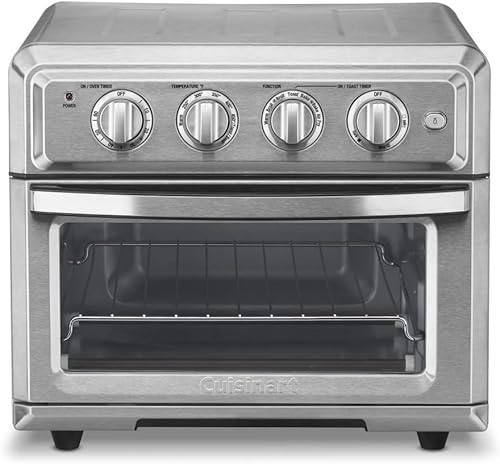
If you cook for one or two people, a model in the 1,200 to 1,500 watt range with a 5 to 7 quart basket is plenty. The NutriChef PKAIRFR48 draws 1,200 watts and holds 13 quarts, giving a gentler draw with generous capacity. The Nuwave 15.5-Qt Family Size comes in at 1,500 watts and is designed for larger batches, so the power is spread across more food. If you want maximum versatility and quick heat-up, a 1,800-watt model like the Cuisinart TOA-60ES handles a wide range of tasks with speed. Choose based on how many people you feed, not on chasing the lowest watt count.
Tips to Keep Running Costs Low
Batch cooking is the biggest lever you have. Instead of running the air fryer twice for two small portions, cook everything at once. Preheating is usually not necessary for most foods, which saves a few minutes of draw time every session. Keeping the basket clean helps airflow stay efficient, so the element does not have to work harder to compensate. If you have a time-of-use electricity plan, running the air fryer during off-peak hours can shave a few more cents per session.
The Bottom Line on Air Fryer Electricity Use
For typical daily use, an air fryer adds a few dollars per month to your electric bill, not tens of dollars. Compared to keeping a conventional oven on for the same number of meals, you will likely save energy overall. The exact amount depends on your local rate, your model's wattage, and how long each cooking session runs. Air fryers are not energy hogs, and for most households they represent a straightforward way to reduce oven use without sacrificing hot, crispy results.
Frequently asked questions
How much does it cost to run an air fryer every day?
At the U.S. average electricity rate of around 16 cents per kWh, running a 1,700-watt air fryer for 20 minutes a day costs roughly $2.75 to $3.50 per month. Your actual cost depends on your local rate and how long each cooking session lasts.
Does an air fryer use more electricity than a microwave?
Not by much. Most microwaves draw 1,000 to 1,200 watts, while a typical air fryer draws 1,200 to 1,800 watts. However, air fryers often run for longer per session than a microwave, so the total energy per use can be somewhat higher depending on the task.
Can I leave an air fryer on all day without a big power bill?
You should not leave an air fryer running unattended, and doing so would indeed run up your electric bill. For normal cooking sessions of 15 to 30 minutes, the cost is low. Extended or continuous use is not what these appliances are designed for.
Do larger air fryers use more electricity?
Larger models generally have higher wattage ratings, but they also cook more food at once. If you would otherwise run a smaller air fryer in multiple batches to get the same amount of food done, a larger model might use less total electricity by finishing the job in one cycle.
Is an air fryer cheaper to run than a toaster oven?
They are in a similar range since both draw roughly 1,200 to 1,800 watts. The real difference is how quickly each one preheats and cooks. Air fryers generally move hot air more aggressively, which can cut cook time and total energy use for many common foods.