Air Fryer vs Oven: Which One Costs Less to Run?
The answer depends on what you are cooking, but air fryers almost always win on smaller meals.
If you have ever wondered whether your air fryer is actually cheaper to run than your regular oven, you are not alone. The short answer is yes, for most everyday cooking tasks an air fryer uses noticeably less electricity. But the gap is bigger for some foods than others, and a few situations actually favor the oven. Here is a plain-numbers look at how the two compare so you can make the choice that fits your kitchen and budget.
Products mentioned in this post


How Wattage Translates to Real Cost
A standard full-size electric oven draws roughly 2,000 to 5,000 watts depending on whether you are using one element or both, and it typically takes 10 to 15 minutes to preheat before cooking even starts. Air fryers in this category sit mostly in the 1,200 to 1,800 watt range and are ready to cook in 3 to 5 minutes. To figure out cost, multiply watts by hours of use and divide by 1,000 to get kilowatt-hours (kWh), then multiply by your local electricity rate. At the US average of around 16 cents per kWh, an 1,800-watt air fryer running for 20 minutes costs about 10 cents, while a 3,500-watt oven running for the same time costs roughly 19 cents, not counting preheat time.
The Preheat Factor Makes a Big Difference
Preheat time is where the oven loses a lot of ground in the cost comparison. A conventional oven may pull 3,000 watts or more during preheat, and that energy is spent before a single piece of food goes in. Air fryers skip or dramatically shorten this phase, with most models reaching cooking temperature in under five minutes. If you are cooking a batch of fries or a couple of chicken thighs, you might spend nearly as much energy preheating the oven as the air fryer uses for the entire cook. Over a month of daily use, that preheat difference alone can add a couple of dollars to your electric bill.
When the Air Fryer Clearly Wins
For meals that serve one to four people, the air fryer almost always costs less to run. Frozen snacks, chicken wings, vegetables, fish fillets, and reheated leftovers are all cases where the air fryer finishes faster and uses less electricity start to finish. The Nuwave 15.5-Qt Brio draws 1,500 watts and handles a surprising amount of food for a family while still staying well under oven-level energy use. Compact models like the Chefman RJ38-2 at 1,500 watts are even more efficient for single servings. As a rough guide, if the food fits in the air fryer basket, you will spend less running the air fryer.
When the Oven Still Makes More Sense
For large holiday meals, whole roasts, multiple sheet pans of cookies, or any time you need to fill racks with food, the oven can actually be the more cost-effective choice per pound of food cooked. Splitting a full batch across two or three air fryer cycles burns more total energy than one oven run covering everything at once. The oven is also the better pick for items that need a wide, flat cooking surface, like a full pizza or a large casserole dish. In those cases the air fryer would require multiple batches that more than erase its per-cycle savings.
Air Fryer Oven Combos: A Middle Ground
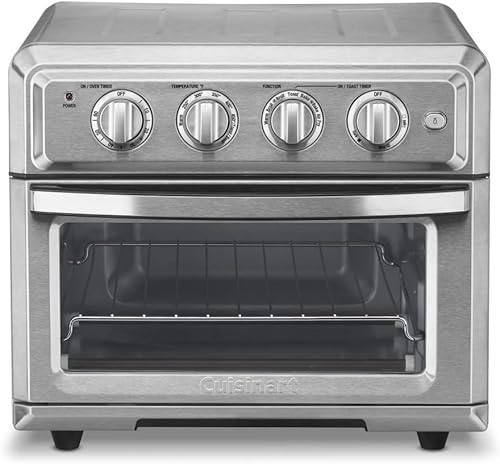
Air fryer ovens like the Cuisinart TOA-60ES, which draws 1,800 watts, sit between a basket-style air fryer and a full wall oven. They have more capacity than most basket models and still use far less power than a conventional oven. These units are a practical pick if you want to air fry larger batches without sacrificing too much counter efficiency. Just keep in mind that larger capacity models with higher wattage will cost more per session than compact basket air fryers, even though they remain cheaper than a standard oven.
How to Estimate Your Own Savings
Pull out a recent electric bill and find your cost per kWh. Then note the wattage of your air fryer from the label on the bottom or the manual. Multiply wattage times cook time in hours times your rate to get the cost per session. Compare that to your oven wattage times its total time including preheat. If you cook in your air fryer five days a week instead of the oven, even saving a dime per session adds up to about $2.60 a month, or around $31 a year. That is not a fortune, but it is real money and most people are cooking in the air fryer more than five times a week.
Other Ways the Air Fryer Saves Indirectly
Lower electricity use is the main story, but there is a secondary one: heat. A full oven dumps a lot of heat into your kitchen, which makes your air conditioning work harder in summer. An air fryer vents a smaller plume of heat and keeps the room noticeably cooler, which can mean small but real savings on cooling costs during warm months. Faster cook times also mean less time standing in the kitchen, and for busy weeknights that kind of practical efficiency matters just as much as the cents on your power bill.
Frequently asked questions
Does an air fryer use less electricity than an oven?
Yes, in most cases. Air fryers draw 1,200 to 1,800 watts compared to 2,000 to 5,000 watts for a full-size electric oven. They also reach cooking temperature much faster, so total energy per meal is significantly lower for smaller portions. The savings narrow or disappear when you are cooking enough food to fill an entire oven.
How much does it cost to run an air fryer for 20 minutes?
At the US average electricity rate of about 16 cents per kWh, a 1,700-watt air fryer running for 20 minutes costs roughly 9 cents. A 1,200-watt model at the same time costs closer to 6 cents. Your actual cost depends on your local rate and the wattage of your specific model, both of which you can find on your electric bill and the appliance label.
Is it cheaper to cook a whole chicken in an air fryer or an oven?
For a smaller bird that fits in a large basket or air fryer oven cavity, the air fryer is usually cheaper because it preheats faster and finishes faster. For a large roasting chicken that requires a full conventional oven, the oven may be comparable in total cost because it handles the job in one go without needing multiple cycles.
Can switching to an air fryer really lower my electric bill?
It can make a small but measurable difference, particularly if you currently use your oven for everyday meals. The savings are most noticeable for households that cook dinner daily. Replacing oven use five days a week with an air fryer can add up to $25 to $40 per year depending on your local electricity rate and the models involved.
Do air fryers cost more in electricity than a microwave?
Yes, a microwave typically draws 900 to 1,200 watts and reheats food in a few minutes, making it the cheapest countertop appliance for reheating purposes. An air fryer costs more per session but produces results that are much closer to oven-quality, with crispier textures that a microwave cannot replicate. For actual cooking rather than just reheating, the air fryer is the better value.